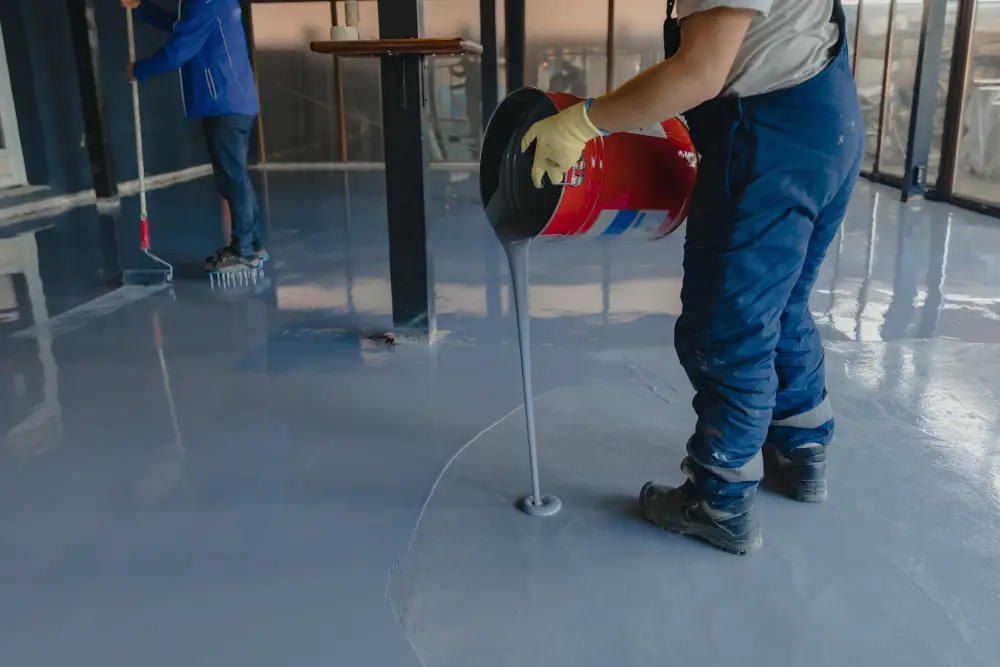
“Is epoxy flooring slippery?” comes up a lot, and the honest answer is: it depends entirely on the finish. A high-gloss, smooth epoxy floor can be genuinely slippery when wet; a textured or additive-broadcast finish can be very grippy. Rather than a single yes-or-no answer, it helps to understand how slip resistance is actually measured in Australia, and what that means for choosing a finish.

Why Slip Resistance Matters More Than People Realise
Slips, trips and falls are a genuinely significant workplace and household injury category – industry reporting citing Safe Work Australia data puts slips, trips and falls at around 21.8% of serious workers’ compensation claims in 2023–24, second only to body-stressing injuries. For a garage, kitchen or commercial floor that regularly gets wet, grip underfoot isn’t a cosmetic afterthought.
How Slip Resistance Is Actually Measured in Australia
The relevant Australian Standard is AS 4586-2013, Slip resistance classification of new pedestrian surface materials, published by Standards Australia. It sets out test methods and classification systems for how slip-resistant a surface is – most commonly the wet pendulum test (giving a P1–P5 classification, from lowest to highest slip resistance) and the ramp test (giving an R9–R13 classification). A companion guide, SA HB 198:2014, helps specifiers work out which classification suits a given application – a wet external ramp needs a higher rating than a dry, low-traffic internal floor, for instance.
What This Means for an Epoxy Floor
Epoxy itself doesn’t have one fixed slip rating – it depends entirely on the finish applied. A smooth, high-gloss epoxy topcoat sits toward the lower end of slip resistance, especially wet. A textured flake finish, a matte or satin topcoat, or a broadcast anti-slip aggregate all improve grip, and the right choice depends on how wet the area gets and how it’s used.
Getting a Specific Rating for Your Project
For most residential floors – a garage, a laundry, a home patio – choosing a textured or additive finish appropriate to how wet the area gets is generally sufficient, without needing formal test certification. For a commercial or industrial project where a specific slip rating is a compliance requirement – a commercial kitchen or a workplace with a duty-of-care obligation, for example – that’s a conversation to have directly with your installer and, where relevant, a building surveyor or certifier, since a specific certified rating needs to be tested and documented, not assumed from general marketing claims.
This is general guidance to help you ask the right questions. For a specific certified slip rating requirement, confirm current standards and testing requirements with your installer, building surveyor or certifier rather than relying on this or any general article.