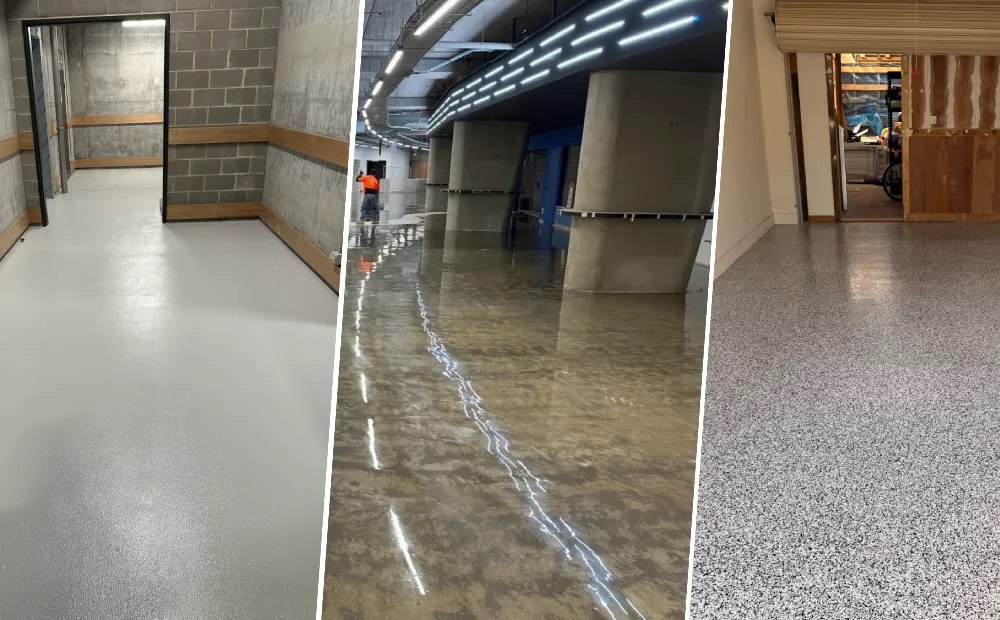
Decorative epoxy flooring isn’t a single look – it’s a category covering three genuinely different finishes, and picking between them shapes how your floor looks, how it performs day to day, and what it costs. Here’s a straightforward look at solid colour, flake and metallic epoxy, so you know which conversation to have with your installer.

The Three Main Decorative Epoxy Styles
Solid colour epoxy
A single, uniform colour across the whole floor. It’s the simplest and most budget-friendly of the three, and it gives a clean, minimal look that suits workshops and utility spaces well. The trade-off is that dust, scuffs and hot tyre marks show up more clearly on a flat, uniform surface than they do on a textured or patterned finish.
Decorative flakes are broadcast into the base coat and sealed under a clear topcoat, giving a textured, terrazzo-like look. It’s a genuinely practical choice – the mottled pattern hides everyday dust and minor marks far better than a solid colour, and the texture adds a bit of extra grip underfoot. This is the most common choice for garages, workshops and other high-traffic areas.
Metallic epoxy
Metallic pigments are blended into the epoxy and move as it cures, creating a three-dimensional, flowing effect that’s often compared to molten metal or moving water – no two metallic floors ever look quite the same. It’s the most visually striking of the three options, and it suits feature spaces – a showroom, a styled garage, an open-plan living area – where the floor itself is meant to be a talking point.
Which Style Suits Which Space?
As a general guide: solid colour works well for workshops and back-of-house areas where budget and simplicity matter most; flake is the practical all-rounder for garages, workshops and busy family spaces that need to hide daily wear; and metallic suits a feature space where the look matters as much as the durability – living areas, retail showrooms, or a garage that’s as much a showpiece as a place to park.
Durability: Does the Look Affect Performance?
All three are built on the same underlying epoxy system, so the core durability – resistance to chemicals, impact and daily wear – is broadly similar. Where they differ is how well each finish hides wear over time: flake tends to be the most forgiving day to day, solid colour shows marks the most readily, and metallic sits in between, depending on the pattern and gloss level chosen.